|
Introduction
Los Angeles,
city in southern California, the
most populous city in the state and the second most populous city and
metropolitan region in the United States,
after New York City. Located on the Pacific Ocean near the U.S. border
with Mexico, the metropolis is noted for its pleasant climate and
scenic setting. It is situated on a hilly coastal plain surrounded by
beaches in the west and mountains and deserts in other directions.
Referred to casually as “LA,” Los Angeles is one of the major
industrial, commercial, and financial centers of the United States. It
is known especially for its motion-picture, aeronautics, and aerospace
industries. This international, multicultural city is also home to the
largest Mexican, Korean, Salvadoran, and Guatemalan populations
outside of those countries. Los Angeles has grown at a phenomenal rate
since the late 19th century. Since the 1920s it has been the leading
city of California as well as the most important metropolis west of
the Mississippi River.
Decades of self-promotion and the
global reach of the movies and television shows set in the city have
broadcast a glorified image of Los Angeles around the world. The city,
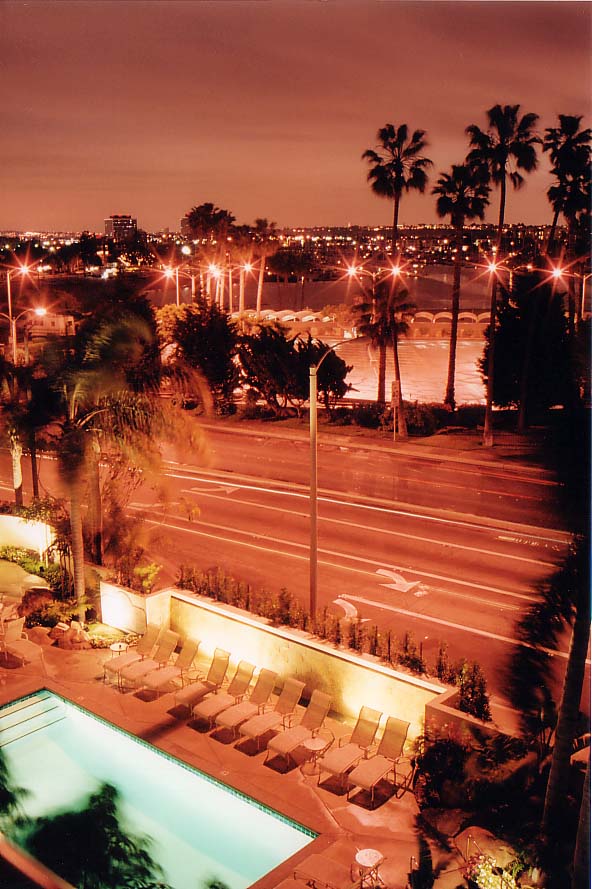
with its palm trees, beaches, and swimming pools, has been idealized
as the ultimate “American Dream” for millions in the United States and
abroad. As an immigrant metropolis on the Pacific Rim, it faces the
problems and prospects of modern society on a larger scale than almost
any other U.S. city. Therefore, Los Angeles is often looked to for
important national and global trends.
Los Angeles has a Mediterranean
climate, with hot, dry summers and mild, wet winters. This gives the
region a year-round growing season suitable for everything from cacti
and citrus fruits to walnuts and corn. Temperatures vary widely from
the desert regions to the high mountains, but July averages range from
highs of 24° C (75° F) and lows of 17° C (63° F). January averages
range from highs of 19° C (66° F) to lows of 9° C (48° F). The Pacific
Ocean moderates the climate, providing a periodic layer of fog to the
coastal areas. Rainfall is greatest in the mountain zones, averaging
760 to 1,020 mm (30 to 40 in) a year, and lowest along the coastal
zones, which receive an average of 250 to 381 mm (10 to 15 in)
annually. Interaction between these two climatic zones causes hot and
dry winds (called Santa Ana winds) to blow downward from the mountains
to the coast during the late summer and fall. Sometimes fierce and
dangerous, these winds can reach 110 km/h (70 mph) and are often
responsible for fanning wildfires.
Los Angeles traces its origins to a
tiny, 18th-century colonial settlement at the extreme northern
frontier of the colony of New Spain. The Spanish colonial governor
Felipe de Neve originally named the settlement El Pueblo de Nuestra
Señora Reina de Los Angeles del Río de Porciúncula (The Town of
Our Lady Queen of the Angels of the River Porciúncula). However, both
the town and the river soon became known simply as Los Angeles
(The Angels).
Los Angeles and Its
Metropolitan Area
The City of Los Angeles is the seat
of Los Angeles County, which includes most of the Los Angeles-Long
Beach metropolitan area. In turn, Los Angeles County is at the heart
of the Los Angeles-Riverside-Orange County Consolidated Metropolitan
Statistical Area (CMSA), a vast metropolitan region that stretches
from the Pacific Ocean in the west to the San Gabriel Mountains in the
north to the Mohave Desert in the east and to the San Diego
Metropolitan Statistical Area in the south.
In many respects the Los Angeles
region is highly centralized around its core, the City of Los Angeles.
In other respects, Los Angeles is very dispersed and fragmented, often
described as “100 suburbs in search of a city.” This observation is
especially true of the residential and commercial districts. Although
outlying cities once may have been considered suburbs of the City of
Los Angeles, today the metropolitan area consists of literally
hundreds of central business districts, each surrounded by suburb-like
rings, which fade again into adjacent downtowns. Even within the City
of Los Angeles proper there are several distinct central business
districts marked by clusters of skyscrapers.
City of Los Angeles
The City of Los Angeles comprises
1,215 sq km (469 sq mi) and had a population of about 3.7 million
people at the 2000 census. It is the largest municipality (in terms of
size and population) among all the cities in Los Angeles County. It is
irregular in shape because it has grown over the years through the
annexation of surrounding territory and cities. The city proper is
shaped like a lighted torch, its narrow handle extending north from
the Port of Los Angeles to downtown Los Angeles, and its flames
flickering irregularly to the north, west, and northwest. Several
separate cities—such as Beverly Hills, Santa Monica, and Culver
City—are partly or completely surrounded by the City of Los Angeles.
The city is bisected by the Santa Monica Mountains, which run east to
west.
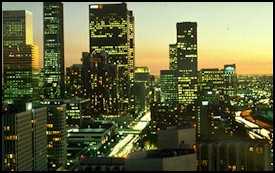
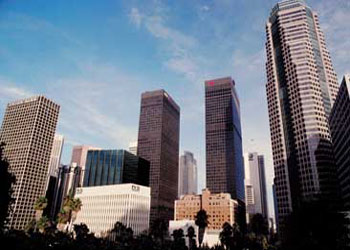
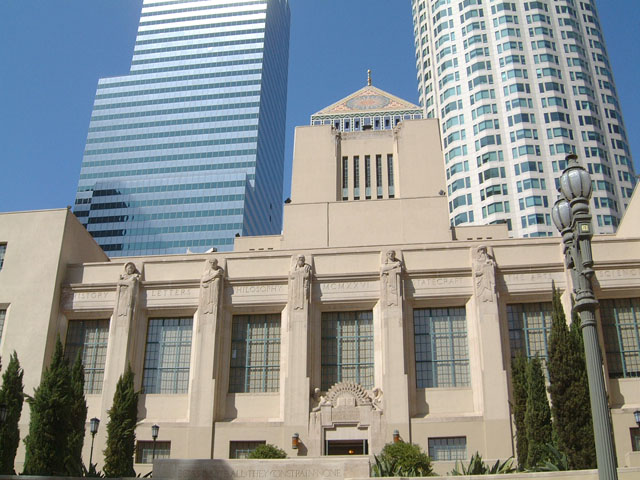
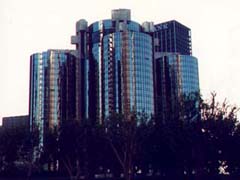
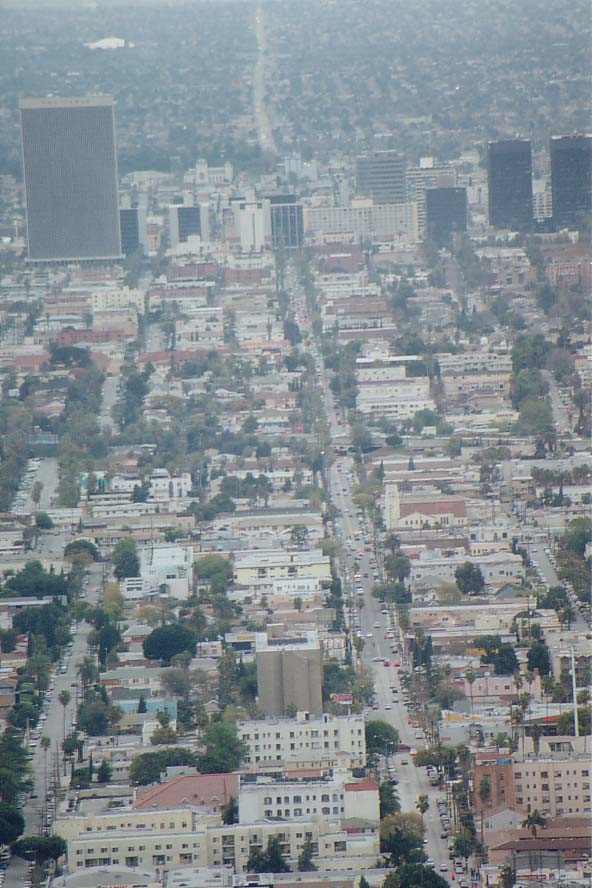
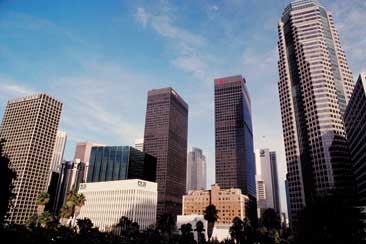
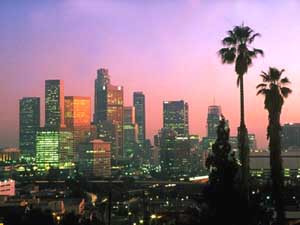
Downtown Los Angeles boasts the
tallest skyscraper west of the Mississippi (Library Tower) and the
most visible skyline of the many surrounding business centers. Prior
to the 1950s the most visible architectural landmark of the region was
the distinctive pyramid-topped Los Angeles City Hall, which is now
dwarfed by surrounding tall office towers. El Pueblo de Los Angeles
Historical Monument preserves a historic Spanish and Mexican
neighborhood on the north side of downtown Los Angeles. The historic
site includes the Avila Adobe, built in 1818 and the city’s oldest
building. The Staples Center, a major sports arena, is located in
western downtown Los Angeles.
Several predominantly Asian
neighborhoods surround downtown Los Angeles: Koreatown to the west,
Chinatown to the northeast, and Little Tokyo to the east. The city’s
futuristic four-level freeway interchange (the first high-speed
freeway interchange in the world) opened west of downtown in 1953,
soon becoming the leading icon of Los Angeles. Dodger Stadium is
located north of Chinatown. East of downtown is East Los Angeles, home
to a large Hispanic population.
South of downtown, the city tapers
sharply after the University of Southern California campus and
Memorial Coliseum, the only site in the world to host two Olympic
Games (1932 and 1984). Predominantly Latino residential neighborhoods
located to the south make up an area known as South Central Los
Angeles. One of these neighborhoods is Watts, home to the 30-m
(100-ft) Watts Towers, decorated with shells, broken glass, and tile.
Farther south is the very narrow Alameda Corridor, which links South
Central Los Angeles with Harbor City, San Pedro, and the Port of Los
Angeles, at the southern tip of the city. Los Angeles International
Airport (LAX) is located west of Watts. The Theme Building at LAX was
constructed in 1962 and immediately joined the four-level freeway
interchange as another major icon of the city.
Hollywood, the traditional mecca of
the motion-picture industry, is located northwest of downtown Los
Angeles. In the hills north of Hollywood are the Hollywood Bowl and
Griffith Park. The Hollywood Bowl, which opened in 1916, is a large
natural amphitheater used for music, dance, and other performances.
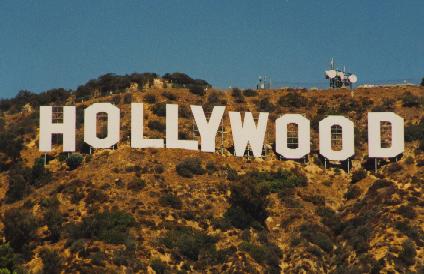
Also in the hills is another major icon of the Los Angeles region: a
huge sign spelling out “HOLLYWOOD” in 15 m- (50 ft-) tall letters,
originally constructed in 1923 as a real estate promotion.
Southwest of Hollywood are
Westwood—home of the University of California, Los Angeles—and Century
City, headquarters of many motion-picture and broadcasting companies.
North of Westwood and Century City, and on the other side of the Santa
Monica Mountains, is the vast San Fernando Valley. The valley is
dotted with commercial centers ringed by residential neighborhoods
such as Studio City, Van Nuys, and Northridge.
Los Angeles County
Los Angeles County covers 10,518 sq
km (4,061 sq mi) and had a population of about 9.5 million people at
the 2000 census. Encompassing 88 cities, it is the most populous
county in the United States (if it were a state, it would be the 9th
largest). After the City of Los Angeles, the next largest city in the
county is Long Beach (2000 population, 461,522), located east of the
Port of Los Angeles. The city of Compton (93,493) is located north of
Long Beach, on the east side of the Alameda Corridor. On the other
side of the corridor are the cities of Torrance (137,946) and
Inglewood (112,580).
Northwest of Inglewood and west of
downtown Los Angeles are the wealthy and fashionable Santa Monica
(84,084) and Beverly Hills (33,784). Both cities are enclaves: Santa
Monica is surrounded by the City of Los Angeles to the north, east,
and south (with the Pacific Ocean to the west); and Beverly Hills is
completely encircled by the city.
West to east, the cities of Burbank
(100,316), Glendale (194,973), and Pasadena (133,936) are located
north of downtown Los Angeles. Further to the east is Pomona
(149,473), near the eastern border of Los Angeles County. Los Angeles
County also includes two of the offshore Channel Islands: Santa
Catalina and San Clemente.
Greater Los Angeles
Greater Los Angeles, or the Los
Angeles-Riverside-Orange County Consolidated Metropolitan Statistical
Area (CMSA, a standard U.S. Census Bureau designation), includes Los
Angeles, Orange, Riverside, San Bernardino, and Ventura counties. In
2000 the Los Angeles CMSA was the second-largest CMSA in the United
States (after the greater New York CMSA) in terms of population, with
16,373,645 people. Since the 1980s, when most of the livable space of
central Los Angeles and Orange counties was occupied, the
fastest-growing areas have been on the eastern extent of the
metropolis, in Riverside and San Bernardino counties.
Besides those already listed, the
principal cities of the Los Angeles CMSA are Santa Ana (337,977) and
Anaheim (328,014), in Orange County (southeast of Los Angeles County);
San Bernardino (185,401) and Riverside (255,166), in San Bernardino
and Riverside counties (to the east) and Oxnard (170,358) and Ventura
(officially San Buenaventura, 100,916), in Ventura County, which marks
the western extent of the Los Angeles CMSA.
Population
The population of the Los Angeles
metropolitan region has grown spectacularly since the 1880s, when the
city was barely more than a minor cow town. By 1920 the population of
Los Angeles County (the most consistent area of comparison) had
reached nearly 1 million. Another 1 million arrived during the 1920s
alone, a period in which Los Angeles’s basic dispersed urban and
residential patterns were established.
Continuing Growth
In the 1930s and 1940s, the region
also received two waves of major migrations: that of farm families
from the southern Great Plains migrating west to escape the Dust Bowl,
and that of African Americans moving out of the American South. During
World War II (1939-1945) the need for labor, especially in ship and
aircraft production, boosted the population even more. The population
of Los Angeles County jumped from 3 million to 4.7 million between
1940 and 1950.
The population explosion continued
from the 1950s through the 1970s. The increase in this period can be
attributed to the Cold War demand for the region’s defense industries,
but also to U.S. popular culture. Attractive images of Los Angeles
beaches, palm trees, convertible cars, and backyard swimming pools
flooded U.S. movies, television programs, and advertising. Primarily
thanks to Los Angeles, in 1970 California became the most populous
state in the United States. Although the growth rate slowed in the
1980s and 1990s, the absolute population has continued to rise. In the
year 2000, the population of the City of Los Angeles was 3,694,820,
that of Los Angeles County was 9,519,338, and that of the Los
Angeles-Riverside-Orange County CMSA was 16,373,645.
Cultural Diversity
Beside its massive growth, the most
distinctive change in Los Angeles’s population in the second half of
the 20th century was its rapid transformation into one of the most
diverse and multicultural cities in the United States. In 1960
non-Hispanic whites made up 82 percent of the population of Los
Angeles County. At the 2000 census, non-Hispanic whites made up only
32 percent of the county’s population, Asians 11.9 percent, blacks 9.8
percent, Native Americans 0.8 percent, and Native Hawaiians and other
Pacific Islanders 0.3 percent. Hispanics, who may be of any race,
accounted for 44.6 percent of the population. In 1990 Los Angeles
became the first of the largest U.S. cities in which no ethnic or
racial group formed a majority. According to the 2000 census,
non-Hispanic whites made up 30.7 percent of the population of the City
of Los Angeles, blacks 11.6 percent, Asians and Pacific Islanders 10.7
percent, Native Americans 1.1 percent, and people who reported
belonging to more than one racial group 2.4 percent. Hispanics made up
45.1 percent of the city’s people.
The transformation of the city’s
ethnic character is attributable primarily to 1965 reforms in U.S.
immigration policy, officially ending bias in favor of Northern
European immigrants and opening the doors to massive immigration from
Latin America and Asia. Los Angeles, with its historic connections to
and proximity with Mexico, as well as its prominent position on the
Pacific Rim, became the nation's leading port of entry for immigrants.
In the early 21st century, more than 20 languages were spoken in the
public schools, the principal languages being English and Spanish.
Literally hundreds of religions and denominations are practiced in Los
Angeles, especially Protestantism, Catholicism, Buddhism, Judaism,
Islam, and Hinduism.
After 1965, the Hispanic (often
called Latino in California) population grew rapidly. The Mexican
community is particularly significant, making up 79 percent of the
region’s Hispanic population. More Mexicans live in Los Angeles than
in any city except Mexico City. The region has also attracted large
numbers of immigrants from Central America—people from El Salvador,
Guatemala, and Nicaragua form the largest Hispanic communities after
those of Mexican origin.
Asian peoples began migrating to the
region in large numbers during the Gold Rush of 1849. Chinese were the
most numerous Asian group until the early 20th century, when large
numbers of Japanese immigrants temporarily supplanted them. A
community of Korean political exiles settled in Los Angeles during the
years of the Japanese occupation of Korea (1905-1945) and became the
nucleus of a much larger Korean American community after 1965. By 1990
Los Angeles was home to the largest Korean community outside of Korea
itself. Filipinos have immigrated to Los Angeles primarily in search
of economic opportunity. Vietnamese have come to the region
principally as refugees since the end of the Vietnam War (1959-1975)
and the start of new conflicts in Southeast Asia in the 1970s. In 2000
the largest Asian groups in Los Angeles County were Chinese (29.0
percent), Filipinos (22.9 percent) Koreans (16.4 percent), Japanese
(9.8 percent), and Vietnamese (6.9 percent).
Los Angeles, with more than 600,000
Jews, is home to the second-largest Jewish community in the United
States after greater New York. Jews from Eastern and Northern Europe
first settled in the area in the 19th century, and Jewish immigration
increased dramatically during Germany’s Nazi dictatorship from 1933 to
1945. After World War II large groups of Jews from the Middle East
also made their home in Los Angeles. Prominent among these later
Jewish immigrants are refugees from the 1979 Islamic Revolution of
Iran, who usually call themselves Persians.
Other large southwest Asian and
Middle Eastern communities include Armenians, Arabs, Iranians, and
Israelis. These groups have grown dramatically since 1970 primarily
because of conflict in their home regions, but also because of the
search for educational and economic opportunities.
Education and Culture
Los Angeles, despite being a relatively
new metropolis, boasts a remarkable array of world-renowned
educational and cultural institutions. It can also easily claim to be
the birthplace and capital city of the global popular culture industry,
led by Hollywood movies. While many would dispute calling the
entertainment industry "culture," the industry’s enormous
concentration of talent has drawn some of the world's leading creative
geniuses, including German playwright Bertolt Brecht, German author
Thomas Mann, Anglo-American writer Christopher Isherwood, and American
author William Faulkner.
Education
The University of California, Los
Angeles (UCLA), founded in 1919, is Los Angeles’s leading public
university, and the largest campus in California. UCLA’s faculty
includes many Nobel Prize winners and world-renowned scholars in many
fields. Besides UCLA, three other University of California (UC)
campuses serve the Los Angeles region: UC Irvine (1965), UC Riverside
(1954), and UC Santa Barbara (1909). There are also five campuses of
the California State University (CSU) system: California State
Polytechnic University, Pomona (1938), CSU Dominguez Hills (1960), CSU
Fullerton (1957), CSU Long Beach (1949), CSU Los Angeles (1948), CSU
Northridge (1958), and CSU San Bernardino (1965). In addition, there
are numerous community colleges. Together, the Los Angeles region’s
public universities and colleges enroll hundreds of thousands of
students per year.
The city
is also home to several major private colleges and universities. The
University of Southern California (USC), founded in 1879, is the
oldest private university in California, with two campuses near the
heart of downtown Los Angeles. USC is known for its world-renowned
School of Cinema-Television, strong science, engineering, and social
science departments, and winning athletic teams. It is also the
largest private employer in the city. The California Institute of
Technology (1891, also known as Caltech), in Pasadena, is one of the
leading science and engineering universities in the world. Caltech
operates the Jet Propulsion Laboratory (JPL) for the National
Aeronautics and Space Administration (NASA). The JPL is most widely
known for its development of spacecraft and the management of several
space probe programs. Pepperdine University (1937), a private
institution affiliated with the Churches of Christ, occupies a
spectacular campus overlooking the Pacific Ocean in Malibu. The
Claremont Colleges, located in the city of Claremont in the San
Gabriel Valley east of downtown Los Angeles, is a group of six
affiliated schools: Claremont Graduate School (1925), Claremont
McKenna College (1946), the science and engineering-focused Harvey
Mudd College (1955), the liberal arts-focused Pitzer College (1963),
Pomona College (1887), and the all-women’s Scripps College (1926).
Loyola Marymount University (1911) is the oldest and most prestigious
Catholic university in southern California. Occidental College,
founded in 1887, and Whittier College, founded in 1887, are other
highly regarded private colleges in Los Angeles.
Museums and Libraries
The Los Angeles region has numerous
major art museums. The J. Paul Getty Museum has two locations: The
main museum, featuring collections of European paintings, drawings,
sculpture, and decorative arts, is in the massive Getty Center west of
Beverly Hills, while the ancient art collections are housed in a
replica of a Roman villa in Malibu. The Getty Center is also home to
the Getty Research Institute. The Los Angeles County Museum of Art in
midtown Los Angeles houses the largest and most wide-ranging art
collection in the region, with notable collections of American,
European, and Asian art. The Museum of Contemporary Art (MOCA) has an
important collection of works produced since 1940. It has two
locations downtown and one in West Hollywood. The Orange County Museum
of Art in Newport Beach has a significant collection of California
art.
Three
very important smaller museums in Los Angeles were founded by private
collectors. The Norton Simon Museum in Pasadena has a highly renowned
collection of European art. The UCLA Hammer Museum houses some of the
renowned collections of the global industrialist Armand Hammer and
hosts major exhibits. The Huntington Library, Art Collections, and
Botanical Gardens in San Marino house collections of 18th- and
19th-century British and French paintings and an important collection
of books and manuscripts in the fields of British and American history
and literature.
Los
Angeles has many fine museums dedicated to ethnic and cultural themes.
El Pueblo de Los Angeles Historical Monument contains several museums
preserving the earliest Spanish and Mexican heritage of the city. The
Bowers Museum of Cultural Art in Santa Ana contains collections of
East Asian, African, and Native American materials, and the UCLA
Fowler Museum of Cultural History mounts major anthropological
exhibits. The California African American Museum preserves and
interprets the art, history, and culture of African Americans with an
emphasis on California and the Western United States. Other cultural
museums include the Japanese American National Museum, the Korean
American Museum, the Latino Museum of History, Art, and Culture, the
Pacific Asia Museum, and the Southwest Museum, a museum of Native
American artifacts. The Los Angeles Jewish community founded two major
institutions dedicated to intercultural education: the Skirball
Cultural Center near the Getty Center and the Museum of Tolerance in
West Los Angeles.
Los
Angeles is also home to many institutions dedicated to various
industries, sciences, and human endeavors. The Academy of Motion
Picture Arts and Sciences maintains a film archive and a library of
film-related publications, as does the UCLA Film and Television
Archive. The Natural History Museum of Los Angeles County and the
California Science Center include many interactive exhibits. The
Griffith Observatory houses a planetarium and a hall of science, and
mounts exhibitions as well. The Page Museum of La Brea Discoveries
displays the skeletons of animals found in the neighboring Rancho La
Brea Tar Pits, where Ice Age animals were trapped in asphalt deposits.
Other museums on specific themes include the Autry Museum of Western
Heritage, the Huntington Beach International Surfing Museum, the Los
Angeles Maritime Museum, the Museum of Flying, the Museum of Jurassic
Technology, the Museum of Television and Radio, the Petersen
Automotive Museum, and the UC Riverside California Museum of
Photography.
The Los
Angeles Public Library system consists of a large central library and
dozens of branch libraries. The city’s many university and other
institutional libraries house millions of books and rare and archival
materials as well.
Performing Arts and Annual Events
The Music Center of Los Angeles County,
located in downtown Los Angeles, houses the city’s major performing
arts venues: the Dorothy Chandler Pavilion, home to the Los Angeles
Opera and the Los Angeles Philharmonic; and two theaters, the Ahmanson
Theater and the Mark Taper Forum. Major venues outside the City of Los
Angeles include the Pasadena Playhouse, the Orange County Performing
Arts Center in Costa Mesa, and the San Gabriel Civic Auditorium, which
stage everything from seasonal repertory theater to international
ballet performances.
Several
annual festivals have become strong regional traditions in this young
metropolis. The best known worldwide is the Rose Parade, held in
Pasadena on New Year’s Day since the 1890s, featuring elaborate floats
made from live roses and other flowers. The large Mexican American
population celebrates Cinco de Mayo (Fifth of May), which
commemorates the expulsion of the French from Mexico in 1862.
Recreation
The Los Angeles region boasts some
of the finest and most spectacular natural recreation areas in the
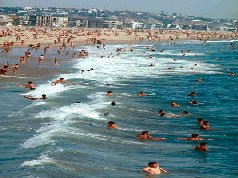
world. The Pacific Ocean beaches—all open to the public—stretch for
more than 100 km (60 mi) and are visited by tens of millions of people
every year. The Santa Monica, San Bernardino, and San Gabriel
mountains have hundreds of miles of hiking trails and numerous
campgrounds, recreational lakes, and ski resorts—all within 100 km (60
mi) of downtown Los Angeles. The Angeles National Forest covers more
than 2,640 sq km (1,020 sq mi) of the San Gabriel Mountains north of
the city and contains Mount San Antonio (also known as Old Baldy), the
tallest mountain (3,068 m/10,064 ft) in the region. The Mohave Desert,
most of which is still wilderness, encircles the region to the north
and east. Santa Catalina Island, lying 30 km (20 mi) off the coast,
contains a popular resort town named Avalon.
Griffith Park, covering 1,700
hectares (4,100 acres), lies at the heart of Los Angeles. Besides many
hiking and equestrian trails, it contains the Los Angeles Zoo and the
Griffith Observatory. The Aquarium of the Pacific in Long Beach
features large-scale marine habitats. Exposition Park, south of
downtown Los Angeles, was created in the late 19th century and
contains a large botanical garden and several museums.
Anaheim's Disneyland, which opened
in 1955, is probably the most famous amusement park in the world. Many
other amusement parks now compete with Disneyland, such as Knott’s
Berry Farm in Buena Park and Six Flags Magic Mountain in Valencia.
Major-league sports venues include Dodger Stadium (opened 1962),
located north of downtown Los Angeles, home of the Los Angeles Dodgers
baseball team; and Staples Center (1999), located downtown, home of
the Los Angeles Lakers, Los Angeles Clippers, and Los Angeles Sparks
basketball teams, as well as the Los Angeles Kings ice hockey team.
The Los Angeles Coliseum, which
hosted the 1932 and 1984 Summer Olympic Games, is the home stadium of
the USC Trojans college football team. It is located in Exposition
Park. The Rose Bowl in Pasadena is the home of USC’s rival football
team, the UCLA Bruins. The Rose Bowl is also the home of the Los
Angeles Galaxy major-league soccer team.
Economy
Los Angeles is a major trade,
manufacturing, and distribution center for the United States, the
Pacific Rim, and the world. Its leading economic sectors include
shipping, manufacturing, communications, finance, and fashion. Its
port is among the busiest in the United States, handling $113.9
billion in cargo value during 2001. Los Angeles is also a center for
advanced industries, notably high-technology and information-related
concerns. It is a leading producer of aircraft, aerospace, and
military equipment, with several large firms engaged as U.S.
government defense contractors. It is also the world capital of the
motion picture, television, radio, and recording industries.
Los
Angeles manufacturing, once remarkable for the production of
automobiles and rubber in large assembly-line factories, has shifted
to smaller enterprises with a greater emphasis on light manufacturing,
refinishing, and recycling. Leading products include garments, food
products, furniture, electronics, and pharmaceuticals. Sitting atop a
series of oil fields, the metropolis is also a major producer and
refiner of petroleum products.
In 1997,
80 percent of the metropolitan region’s labor force worked in
service-related industries (wholesale and retail trade, transportation,
finance, insurance, real estate, and personal or professional
services) and 20 percent were engaged in the production of goods (construction
and manufacturing). Within the service sector, 39.3 percent were
employed in personal and professional services; 29.2 percent in trade;
18.1 percent in federal, state, or local government; and 7.1 percent
in finance, insurance, and real estate.
Entertainment Industry
The motion-picture, television, radio,
and recording industries have been greatly transformed in recent
decades through corporate mergers and the decline of the studio system,
in which studios controlled every stage of the moviemaking process,
from screenwriting to production to distribution to exhibition. From
the 1930s through the 1950s motion pictures were dominated by seven
studios, all headquartered in Los Angeles: Metro-Goldwyn-Mayer (MGM),
Radio-Keith-Orpheum (RKO), 20th Century-Fox, Warner Brothers,
Paramount, Columbia, and Universal. Over the years, antitrust actions
forced studios to split off their theater chains, and the industry
became more and more decentralized. Production is now conducted by
thousands of small independent enterprises, which work on a
film-by-film contract basis, with the major studio corporations acting
as producers. Meanwhile, the studios themselves have been absorbed
into giant entertainment conglomerates such as Sony Corporation, AOL
Time Warner Inc., The Walt Disney Company, and Viacom, Inc. All the
entertainment conglomerates are now competing for customer share of
the Internet market as well.
Transportation
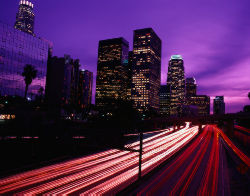
A distinctive feature of the Los
Angeles region is its organization around the principal freeway
corridors. The central east-west corridor is the Santa Monica Freeway
(I-10), which carries hundreds of thousands of vehicles every day
through a string of urban commercial centers from Santa Monica on the
Pacific Ocean to Palm Springs in the Mohave Desert. Three freeways
link the region's central districts in the northwest-southeast
direction, paralleling the Pacific Ocean: the San Diego Freeway
(I-405), the Harbor-Pasadena Freeway (I-110), and the Golden State
Freeway (I-5). The major freeway interchanges each handle hundreds of
thousands of vehicles every day, and the entire regional system
carries millions of vehicles each day.
The Los
Angeles County Metropolitan Transit Authority (MTA) runs the region’s
mass transit system, consisting of buses and light rail, heavy rail,
and commuter rail lines. The Metro Rail system is a mostly
above-ground light rail network serving the core areas with trains and
subways. However, the majority of the mass transit riders use the MTA’s
vast bus network.
Government
There are three main categories of
local government in the Los Angeles metropolitan region: city, county,
and regional authorities. Los Angeles, Orange, Riverside, San
Bernardino, and Ventura counties are the largest units in terms of
population, territory, and budgets. Within these 5 counties are 187
separate municipalities.
The City
of Los Angeles is run by a mayor and a 15-member city council. Each of
the council members represents a distinct district, and both the mayor
and the council members are popularly elected to four-year terms. The
City of Los Angeles operates the Los Angeles Police Department,
Department of Public Works, and other agencies. It also operates
several large and powerful proprietary departments, which are
self-supporting and own extensive land and resource rights. These are
the Department of Water and Power, which holds a near-monopoly on the
region’s water supply; Los Angeles World Airports, which operates Los
Angeles International (LAX), Ontario, Van Nuys and Palmdale airports;
and the Port of Los Angeles, which is one of the busiest ports in the
world.
Each of
the counties is governed by small elected boards of supervisors. Los
Angeles County, the most populous in the United States, is governed by
five supervisors who serve four-year terms. Each supervisor represents
an area in which about 2 million people live. The Los Angeles County
Sheriff’s Department provides basic police services for the more than
2 million people who live in unincorporated county areas or in cities
that use the Sheriff’s Department rather than maintain their own
police departments. The Sheriff’s Department also operates one of the
largest jail systems in the world.
Los
Angeles County operates Marina del Rey, the world’s largest small
craft harbor. It also manages the region’s miles of beaches, which are
used by tens of millions of people every year. In addition, Los
Angeles County operates a massive public health system, with several
major hospitals and dozens of community health care centers.
Several
powerful regional or intergovernmental authorities operate across the
counties and cities: the Metropolitan Transit Authority (MTA), the
Metropolitan Water District (MWD), and the Southern California
Association of Governments (SCAG). The SCAG includes the governments
of Los Angeles, Orange, Riverside, San Bernardino, and Ventura
counties, plus that of Imperial County (located far to the southeast
of the Los Angeles metropolitan area), and of 181 cities within these
counties. It seeks to coordinate city and regional planning and
transportation systems, and provides the public with information about
these two main areas of concern. Its members are appointed by the
member governments.
Contemporary Issues
By the 1980s the expanding metropolis
of Los Angeles had developed an array of serious social problems, many
affecting youth: poor schooling, gangs, drugs, and violence. These
problems reached notorious proportions in the early 1990s, when gang
membership was estimated at 30,000. Youth gangs are concentrated among
poor, working-class, and minority neighborhoods, primarily in the core
of the metropolis. This area includes the South Central portion of the
City of Los Angeles, and also the cities of Compton and Inglewood.
Although youth gangs have been common characteristics of such
neighborhoods in U.S. cities for more than a century, two recent
developments have made them particularly dangerous: the ready
availability of firearms and the involvement of these gangs in the
international narcotics trade. Gangs fight for turf, small territories
in which they retail drugs imported by large organized crime cartels
operating from Colombia and Mexico. Local and federal authorities have
had little success in suppressing this aspect of the gang problem.
A major
contributing problem has been the failure of the public high school
system. Intolerable levels of overcrowding in the central city
schools, crumbling school buildings without working bathrooms, and
poor teacher performance produce high dropout rates and contribute to
the gang and drug problems. The Los Angeles Unified School District
has been targeted for major reforms. In 2000 the district was divided
into 11 subdistricts in the hopes of reducing bureaucracy and
responding more quickly to students’ needs.
Control
of pollution is one area in which Los Angeles has achieved moderate
improvement. The city’s notorious smog—produced mainly by exhaust
emissions from millions of trucks, diesel buses, and automobiles, and
trapped by the Santa Monica and San Gabriel mountains—is still among
the worst in the United States. It is linked to a wide range of health
problems, most noticeably to an alarming increase in asthma among
children. It reached its worst levels in the 1970s, but strict vehicle
emission standards imposed by the federal Environmental Protection
Agency have had a marked effect. Federal and state officials are
working to impose new measures, such as conversion of buses from
diesel to natural gas and lower emission levels from automobile
manufacturers.
Another
major environmental problem has been the pollution of the Santa Monica
Bay. Millions of gallons of untreated runoff from streets and lawns
flow into the bay through storm sewers, especially during the winter
rainy seasons. Dangerous levels of bacteria are regularly found at
many of the beaches. City planners have attempted to have storm drain
runoff diverted into treatment plants.
Los
Angeles continues to struggle to meet its mass transportation needs.
In the late 1990s the Metropolitan Transit Authority (MTA) began
construction on an ambitious subway and surface light rail system.
However, construction costs skyrocketed and, after discovering rampant
mismanagement, federal authorities temporarily shut down the project
and imposed greater oversight. Citizen interest groups forced the MTA
to redirect its funds to the much more widely used bus system.
The
unwieldy size of the City of Los Angeles and the seeming failure of
its educational and transportation efforts have fueled movements in
some communities to break away and form smaller municipalities. Such
movements are particularly strong in the San Fernando Valley and San
Pedro areas. In response, in 2000 the city charter was revised in an
effort to give greater voice to local neighborhoods.
History
The area now called
Los Angeles was settled in about 9,000
bc
by Native American people related to the Shoshone. By the time of
their first contact with Europeans in
ad
1542, these people were divided into three principal groups: the
Tataviam, the Chumash, and the Tongva. The Tataviam, whose territory
lay north of the San Fernando Valley, numbered perhaps 1,000. The
Chumash, with a population of greater than 5,000, lived along the
coastal areas in settlements centered in present-day Santa Barbara,
west of Los Angeles. The Tongva people had the largest
population—perhaps 10,000—and lived along the Los Angeles River. They
called their village—the future site of downtown Los Angeles—Yang-Na.
These Native Americans lived on seasonal hunting, gathering the
plentiful acorns of the evergreen California live oak tree, and
fishing the rich coastal waters. Traveling in canoes and on foot, they
traded with other indigenous peoples far to the north along the coast
and far inland.
After
1519 news traveled along these long-distance trade routes of a strange
new people conquering Mexico: tall, light-skinned men who wore beards
and rode horses. So when the first Spanish explorers landed in 1542 on
the beaches of Los Angeles under the command of Juan Rodríguez
Cabrillo, the Tongva and Chumash were not surprised. Cabrillo,
searching the area for deepwater harbors and potential riches to
plunder, stayed only briefly, and died on the nearby Channel Islands
after being wounded in a battle with the Chumash. After this early
encounter, there was little further European interest in the region
for 200 years.
Los Angeles, photos
|